We would be delighted to be your partner
Do you have any questions? Would you like some advice? Is there a specific problem? Then get in touch with us: we have a solution!
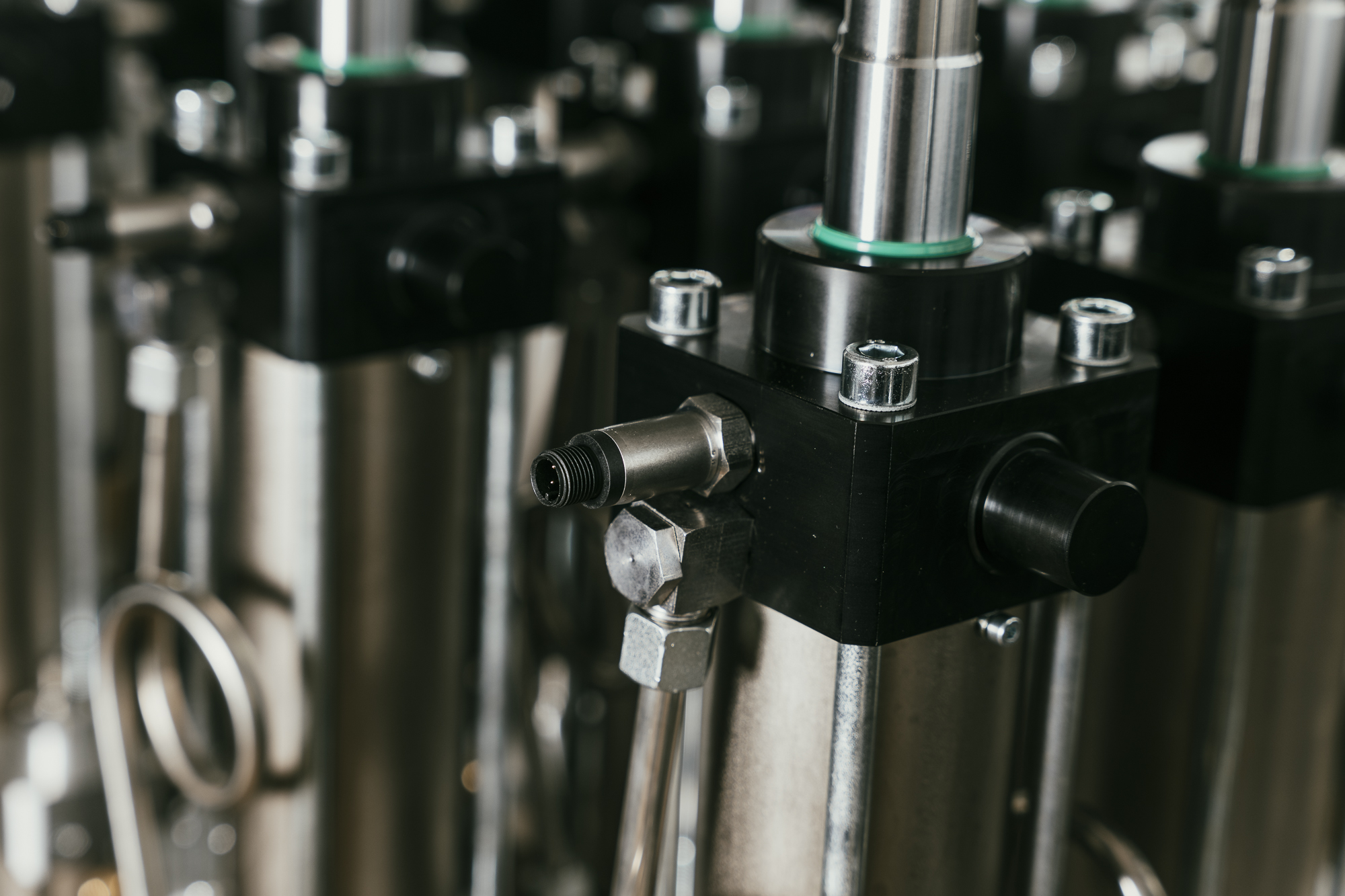
A pneumatic cylinder is an actuator that converts compressed air into linear motion. It is used for lifting, pushing, clamping, positioning or moving workpieces and machine components.
Compressed air is fed into the cylinder and moves the piston. The force generated is transmitted to the application as linear motion via the piston rod.
Pneumatic cylinders are notable for their simple design, high reliability, rapid movement, long service life and relatively low maintenance requirements.
The most common types include standard cylinders, compact cylinders, round cylinders, short-stroke cylinders, guide cylinders, tandem cylinders, rodless cylinders and special-purpose cylinders.
Single-acting cylinders operate in one direction only using compressed air and are usually returned to their home position by a spring. Double-acting cylinders are moved pneumatically in both directions.
The force depends on the operating pressure and the piston area. Larger piston diameters and higher operating pressures result in greater forces.
Most pneumatic systems operate at a working pressure of between 6 and 10 bar. Special versions may be designed for higher or lower pressures.
The design is based on the required force, stroke, speed, installation conditions and the available compressed air supply.
Yes. With the right materials, coatings and seals, pneumatic cylinders are also suitable for use in dusty, damp, corrosive or temperature-sensitive environments.
Aluminium, stainless steel and high-strength steels are frequently used. The choice of material depends on the environmental conditions and the loads involved.
Yes. Many pneumatic cylinders can be fitted with magnetic pistons, proximity switches or position sensors to monitor end positions or intermediate positions.
High-quality compressed air significantly extends the service life of the cylinder. Clean, dry and filtered compressed air reduces wear and tear and minimises malfunctions.
A custom pneumatic cylinder is a cylinder developed to specific requirements, tailored precisely to the needs of a particular application. It is used when standard cylinders do not meet the technical requirements.
A custom cylinder is worthwhile in cases of confined installation spaces, specific environmental conditions, high forces, special stroke lengths or when additional functions need to be integrated.
Virtually all components can be customised, for example stroke, piston diameter, connections, fixings, piston rods, seals, materials or coatings.
Special-purpose cylinders can be manufactured cost-effectively, whether as single units, in small batches or even in large production runs.
Yes. With special seals and materials, versions are available for low temperatures down to below -60 °C or high-temperature applications above +350 °C.
Yes. Stainless steel housings, hard-anodised surfaces or special coatings enable use in damp, salty or chemically corrosive environments.
Yes. Special-purpose pneumatic cylinders can be fitted with linear displacement measurement systems or position sensors to enable precise position monitoring.
Virtually all mounting options, such as flange, base, fork, swivel or custom mountings, can be tailored to individual requirements.
Yes. For example, cushioning, locking, rotary motion, position sensing or force amplification can be combined in a specialised cylinder.
Yes. Thanks to integrated guides or reinforced designs, special cylinders can also be engineered for applications involving high lateral and bending forces.
In addition to standard operating pressures, special cylinders can be designed for particularly low or high operating pressures, as well as for specific media.
Yes. By integrating several functions into a single cylinder, it is possible to reduce the number of components, shorten assembly times and improve operational reliability.
Custom pneumatic cylinders allow for optimal adaptation to the specific application. They improve machine performance, reduce the installation space, increase reliability and often offer a more cost-effective solution than standard components that have been extensively modified.
A telescopic cylinder consists of 2, 3 or 4 nested cylinder stages and allows for long strokes despite a very short overall length.
They are used wherever long strokes are required but the available installation space is severely limited, for example in machinery, vehicles or automation systems.
They save installation space, allow for long travel distances and can be customised to suit the specific application.
Yes. The stroke, number of stages, connections, fixings and materials can all be customised.
The piston diameter of the smallest cylinder stage determines the usable cylinder force.
A tandem cylinder combines two or more pistons in a single housing to generate a significantly greater force whilst maintaining the same piston diameter.
When higher forces are required, but the cylinder diameter cannot be increased due to the available installation space.
They generate greater feed force without increasing the installation diameter, and are ideal for compact machines.
They are frequently used in presses, clamping systems, forming machines and assembly lines.
Smooth-running cylinders are specially designed pneumatic cylinders with a particularly low starting force and minimal friction.
They enable extremely precise movements, high repeatability and a sensitive response.
They are used, for example, in measuring systems, testing equipment, medical technology and for precision positioning tasks.
Thanks to optimised sealing systems, precision-machined guides and high-quality surfaces.
High-temperature cylinders are used in applications where ambient temperatures are consistently high, such as in drying plants, foundries or paint shops.
Depending on the model, operating temperatures of down to around -50 °C or lower are possible.
They feature special seals, lubricants and materials that function reliably even under extreme temperature conditions.
Yes. The temperature range, sealing materials, coatings and corrosion protection are adapted to the specific application.
A pneumatic lifting column is a compact linear actuator capable of moving heavy loads vertically with precision and without tipping.
They offer high guide rigidity, can absorb lateral forces and often do not require any additional external guidance.
Typical applications include ergonomic workstations, assembly lines, handling systems and lifting stations.
Yes. Stroke, load capacity, installation dimensions, connections and fixings can be customised to suit the specific application.
Yes. With integrated position-measuring systems and a suitable control system, pneumatic cylinders can also be used for precise positioning tasks.
The position can be measured continuously using integrated linear position measurement systems, magnetic tape sensors or external position sensors.
Sie kombinieren hohe Dynamik, einfache Integration, robuste Technik und eine energieeffiziente pneumatische Antriebslösung mit präziser Positionierung.
They are used, amongst other things, for guide vane adjustment, format adjustment, metering, workpiece positioning, valve actuation, and in testing and automation systems.
You need to load content from reCAPTCHA to submit the form. Please note that doing so will share data with third-party providers.
More InformationYou are currently viewing a placeholder content from Turnstile. To access the actual content, click the button below. Please note that doing so will share data with third-party providers.
More InformationYou are currently viewing a placeholder content from reCAPTCHA. To access the actual content, click the button below. Please note that doing so will share data with third-party providers.
More Information