We would be delighted to be your partner
Do you have any questions? Would you like some advice? Is there a specific problem? Then get in touch with us: we have a solution!
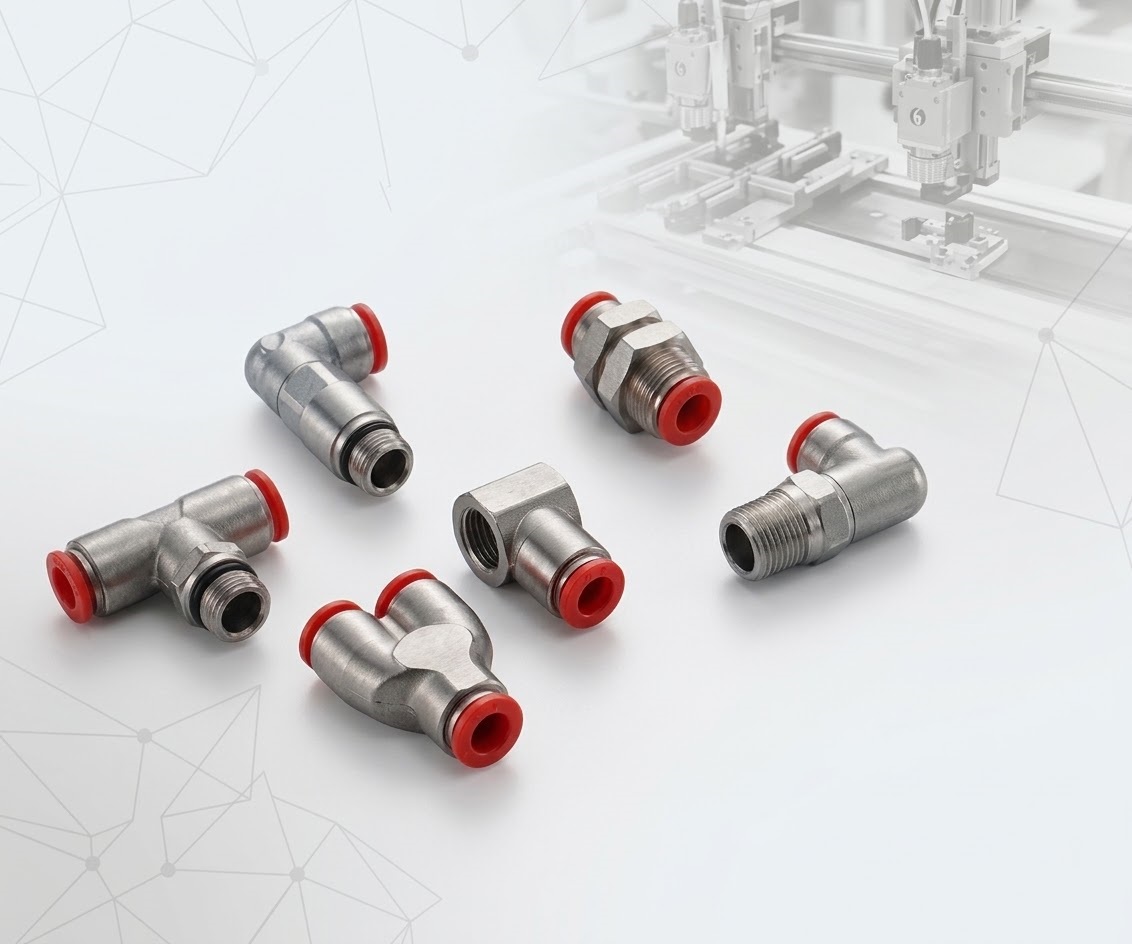
A screw connection securely joins hoses, pipes or conduits to other components of a system.
Common types include push-fit, clamp-ring, union, angle, T-shaped and functional fittings, as well as stainless steel versions.
The most important factors are the thread type, the diameter of the hose or pipe, the operating pressure, the temperature and the medium used.
Depending on the application, screw connections are made from materials such as plastic, brass or stainless steel. The choice of material depends on the medium, pressure, temperature and environmental conditions.
Metric threads, as well as G, R or NPT threads, are frequently used, for example. The threads must be suitable for the application in question.
Ein G-Gewinde ist ein zylindrisches Rohrgewinde nach ISO 228. Es wird häufig bei pneumatischen und fluidtechnischen Anschlüssen eingesetzt.
R threads are tapered external threads in accordance with ISO 7-1. The tapered shape allows the connection to be sealed via the thread.
Metrische Gewinde werden in Millimetern angegeben. Zollgewinde werden beispielsweise in Zollgrößen wie 1/8", 1/4" oder 1/2" bezeichnet.
Temperature affects the load-bearing capacity of the screw connection, seal and hose. You should therefore always take the specified temperature range into account.
Some screw connections can be used for water. However, their suitability depends on the material, the seal and product approval.
That depends on the specific product. The material, seal and chemical resistance must be suitable for the medium being used.
To do this, the hose is inserted directly into the screw fitting. This allows for quick and easy installation.
Clamp ring fittings secure pipes or hoses using a clamp ring and ensure a secure connection.
Sie ermöglichen eine schnelle Montage, benötigen wenig Platz und lassen sich bei geeigneten Ausführungen einfach wieder lösen.
Angle fittings are useful when pipes need to be routed around obstacles or where installation space is limited.
T-fittings enable a pipe to be connected to, or split into, three outlets.
Functional fittings combine the pipe connection with an additional pneumatic function, such as flow regulation.
Stainless steel is particularly suitable for demanding operating conditions and applications with high corrosion resistance requirements.
Typical signs include a loss of pressure, an audible hissing sound or visible leaks. In compressed air systems, leaks can also be detected using suitable testing equipment.
Possible causes include, for example, an incorrect thread, damaged seals, incorrect assembly or an unsuitable screw connection.
That depends on the type of thread and the design. Some connections are sealed by a gasket, whilst others are sealed directly by the thread.
That depends on the design. Screw-in fittings are often detachable, whilst seals or clamping components may need to be replaced, depending on the application.
The hose and fitting must be selected appropriately and fitted in accordance with the manufacturer’s instructions. The hose should be clean and cut straight.
Common faults include incorrect threads, hoses fitted at an angle, damaged seals or the fitting being overtightened.
The bend radius indicates how tightly a hose can be bent without compromising its performance or service life.
If a hose is bent too sharply, this may restrict the flow, damage the hose or put strain on the connection. The minimum bend radius specified by the manufacturer should therefore be observed.
The bending radius depends, amongst other things, on the hose material, outer diameter, wall thickness, pressure and the hose construction.
Depending on the application, materials such as polyurethane (PU), polyamide (PA) or PVC may be used. The degree of flexibility varies depending on the design and manufacturer.
Yes. In confined installation spaces, for example, angled or swivel fittings may be useful to prevent the hose from bending sharply.
Please answer the following four questions so that we can better respond to your request.
Please complete the following form to get in touch with us.
Please enter your contact details.
We will contact you immediately!
You need to load content from reCAPTCHA to submit the form. Please note that doing so will share data with third-party providers.
More InformationYou are currently viewing a placeholder content from Turnstile. To access the actual content, click the button below. Please note that doing so will share data with third-party providers.
More InformationYou are currently viewing a placeholder content from reCAPTCHA. To access the actual content, click the button below. Please note that doing so will share data with third-party providers.
More Information