We would be delighted to be your partner
Do you have any questions? Would you like some advice? Is there a specific problem? Then get in touch: we have a solution!
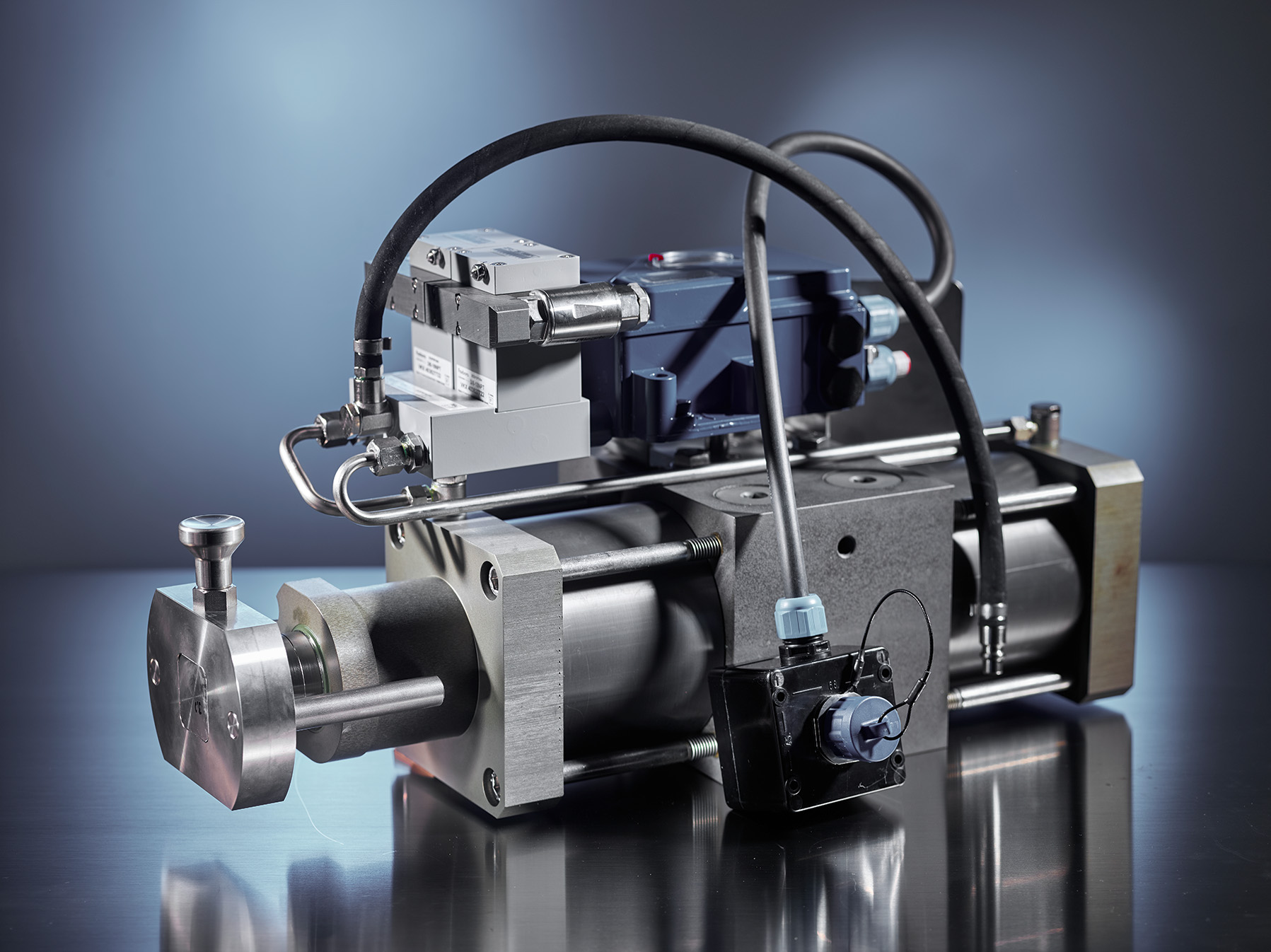
A rotary actuator is a compact swivel actuator designed to convert linear piston movement into a defined rotary motion.
Power is transmitted via:
• piston movement
• rack
• pinion shaft
The DSO is available in various versions:
DSO-P – Pneumatic version
• Operated by compressed air
DSO-H – Hydraulic version
• Operated by hydraulic oil
DSO-HPE – Hydropneumatic version
• Compressed air as the power source
• Hydraulic system for motion control
The following rotation angles are available as standard:
• 45°
• 90°
• 180°
• 270°
• 360°
• Multiple rotations exceeding 720°
Special angles can be customised to meet specific customer requirements.
The following are also available:
• Multi-position actuators
A travel limit allows the maximum possible angle of rotation to be set mechanically.
Example:
A DSO with a 90° angle of rotation can be mechanically limited to a smaller angle, e.g. 60°.
Advantages:
• precise adaptation to the application
• simple mechanical adjustment
The required torque depends on several factors:
• Weight of the load being moved
• Lever arm or distance from the axis of rotation
• Frictional forces
• Acceleration forces
• Speed
• External forces
• Mounting position
Series Piston diameter
DSO-50 50 mm
DSO-63 63 mm
DSO-80 80 mm
DSO-100 100 mm
DSO-125 125 mm
DSO-160 160 mm
DSO-200 200 mm
DSO-P refers to the pneumatic version of the DSO rotary actuator.
The rotary motion is produced by alternately supplying compressed air to the two cylinder chambers.
The maximum operating pressure is:
10 bar
The DSO-P is particularly suitable for:
• rapid swivelling movements
• heavy-duty industrial applications
• applications with an existing compressed air supply
• easy installation
• low running costs
• short response times
Typical applications:
• Automation technology
• Damper and valve actuation
• Handling systems
• Mechanical engineering
• Swivel mechanisms
DSO-H refers to the hydraulic version of the DSO rotary actuator.
Movement is achieved by alternately pressurising the two cylinder chambers with hydraulic oil.
The hydraulic system enables:
• very smooth movements
• finely adjustable speed
• high power transmission
• high dynamic response to load changes
• controlled motion sequences
Yes. The connection layout can be adapted to the specific installation situation. The speed is adjusted via separate throttle check valves in the hydraulic lines.
This allows:
• both directions of rotation to be controlled independently
• acceleration and deceleration to be adjusted
Typical applications:
• High-load machinery
• Slow swivelling movements
• Precise motion sequences
• Applications involving varying forces
• Heavy-duty applications
The DSO-HPE combines:
• a simple compressed air power supply
• controlled movement of a hydraulic system
This results in a particularly smooth and precise swivelling motion.
The DSO-HPE enables:
• constant angular velocity
• precise control
• smooth movements
• controlled acceleration
• controlled deceleration
• high repeatability
The DSO-HPE features a closed hydropneumatic system.
Features:
• integrated hydraulic control
• automatic leakage oil compensation
• finely adjustable angular velocity
• hydraulic progressive damping
Pressure compensation counteracts changes in the volume of the hydraulic oil caused by temperature changes.
It compensates for:
• thermal expansion of the hydraulic oil
• minor internal leaks
• changes in volume during operation
This ensures that the system continues to function stably.
Standard version:
DSO-P / DSO-H:
• -10 °C to +80 °C
DSO-HPE:
• +15 °C to +80 °C
Special versions for other temperature ranges are available.
Available versions:
• Standard pinion shaft
• Solid pinion shaft
• Hollow pinion shaft
• Hollow shaft
Available options:
• Stroke limitation
• Shift pin for mechanical feedback
• Magnetic piston for non-contact position detection
• Special corrosion protection
• ATEX version
• Special connections
• Customised modifications
Yes.
DSO rotary actuators can be supplied with ATEX certification for potentially explosive atmospheres.
Depending on the design, positioning can be achieved via:
• mechanical indexing pins
• magnetic pistons with proximity switches
• external displacement or angle sensors
Yes.
DSO rotary actuators can be adapted to meet customer-specific requirements, for example:
• Torque
• Angle of rotation
• Speed
• Shaft profile
• Installation configuration
• Environmental conditions
Please answer the following four questions so that we can better respond to your request.
Please complete the following form to get in touch with us.
Please enter your contact details.
We will contact you immediately!
You need to load content from reCAPTCHA to submit the form. Please note that doing so will share data with third-party providers.
More InformationYou are currently viewing a placeholder content from Turnstile. To access the actual content, click the button below. Please note that doing so will share data with third-party providers.
More InformationYou are currently viewing a placeholder content from reCAPTCHA. To access the actual content, click the button below. Please note that doing so will share data with third-party providers.
More Information